
Hey everyone, it's Mike from the bulk bag filling team at AB, and today I'm breaking down a question I get all the time from new pharmaceutical clients: can a bulk bag filling machine actually be used for filling pharma products? Let's cut through the confusion here-because it's not a straight yes or no, it's all about how you spec the machine, follow regulations, and make sure it fits your product's unique needs. I've been working with packaging equipment for over a decade, so I've seen the good, the bad, and the "wait, that's not allowed" when it comes to pharma and bulk bag setups, and I'm here to share what actually works.
First off, let's get one thing straight: pharma products aren't your standard fertilizer or plastic resin. We're talking about APIs (active pharmaceutical ingredients), excipients, even finished solid doses that need super tight controls over cleanliness, cross-contamination, product integrity, and compliance with FDA, cGMP, and maybe ICH guidelines. So a run-of-the-mill industrial big bag packing machine? Probably not going to cut it. But a customized, pharma-grade big bag filling machine? Absolutely-when it's built with the right features. I've seen clients pull this off for things like lactose monohydrate, microcrystalline cellulose, and even some specialty APIs, as long as they don't skip the critical design steps.
Let's start with the biggest barrier most people run into: contamination risk. Pharma can't afford cross-contamination between batches, right? If a machine was used to fill a different product last, even a tiny residual trace could mess up a pharma batch and lead to tons of waste, or worse, safety issues for patients. So standard bulk bag machines often have hard-to-clean gaps, open-frame designs, or parts that can trap dust and powders-total no-gos for pharma. The good news is we build our Big Bag Filling Machine with what's called CIP (clean-in-place) or SIP (sterilize-in-place) capabilities. Wait, CIP is routine cleaning for most non-sterile pharma, and SIP is for sterile products, so we tailor that to your exact needs.
Let's talk about materials of construction too. For pharma, every part that touches the product has to be 316L stainless steel, not the 304 stuff you'd see for grain or chemicals. It's smoother, doesn't corrode, and is way easier to sanitize. We also use polished surfaces-sometimes even electropolished-so powder doesn't stick, and there are no crevices where old product can hide. That's a non-negotiable for pharma. Also, the machine has to be designed for quick, changeover between products. If you're switching from one excipient to another, you don't want to be taking the machine apart for hours to clean it. Our systems have quick-release connections and tool-less disassembly for contact parts, so changeover time is measured in minutes, not hours. That's a game-changer for pharma facilities that run multiple batches a day.
Next, handling product integrity. A lot of pharma products are sensitive to things like moisture, static, or dust emissions. APIs, for example, can be hygroscopic-meaning they absorb water from the air and clump up, which ruins their potency. So our pharma bulk bag setups have enclosed designs, dust collection systems that are HEPA-filtered, and sometimes even inert gas purging for sensitive products. We also have different feeding options depending on your product. If you have a free-flowing powder, our Gravity-Feed Bag Packaging Machine for Tons Of Material works great-no extra moving parts, less product degradation, perfect for things like talc or certain excipients. But if you have a cohesive, non-free-flowing powder that tends to clump, you need something with more control. That's where our Horizontal Single-Helix Feeding Bag Packaging Machine Per Ton comes in. The helix moves product smoothly without shearing it, so you don't damage particles or create fine dust. For even higher throughput with cohesive products, we have the Horizontal Double Helix Feed Bag Packaging Machine Per Ton, which is built to maintain gentle flow while speeding things up. We work with each client to pick the right feeding system, no one-size-fits-all here.
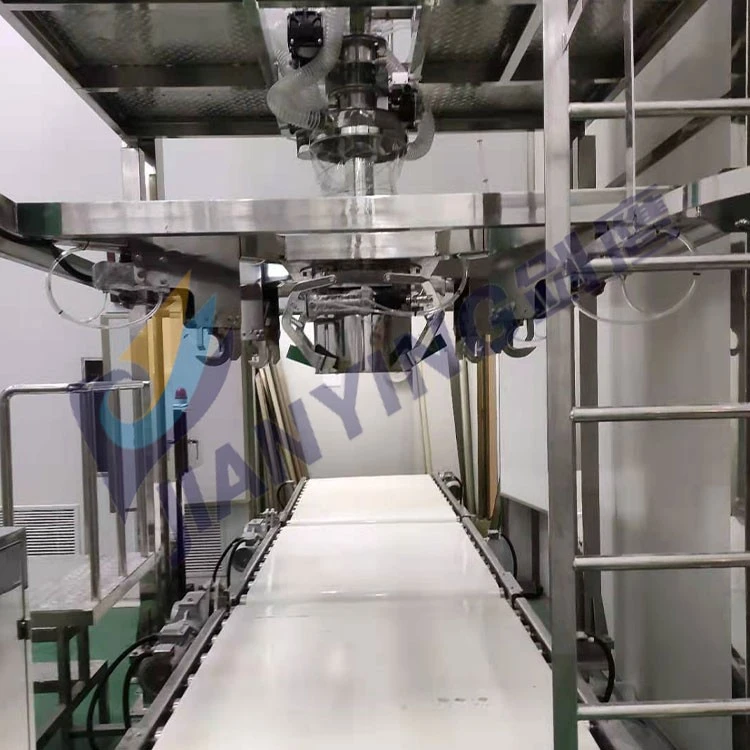
Wait, I know what some of you are thinking: "Bulk bags are 500 to 2,000 kg-can that precision hold for pharma dosing?" That's another common myth. A lot of people assume bulk bag filling is for high-volume, low-precision stuff, but modern pharma bulk bag machines have check-weigh systems, weight verification, and even automated shutoff when the target weight is hit. We can get accuracy within +/- 0.1% of the target weight, which is way more than enough for pharma. Some clients use these bulk bags as intermediate bulk containers (IBCs) to transport materials to downstream processing, so the weight accuracy is critical for consistent batch sizes further down the line. We also have dust suppression features built in-because pharma dust isn't just a contamination risk, it's also a safety hazard for workers, especially if it's inhalable. OSHA has strict limits on pharma dust exposure, so our machines are designed to keep that contained, with explosion-proof options too for certain API dusts that are flammable.
Now, let's get real about compliance. I can talk specs all day, but if it can't pass FDA audits, it's useless. All our pharma bulk bag filling machines are built to meet 21 CFR Part 11, which regulates electronic records and signatures for pharmaceutical facilities. That means the machine's control system tracks every batch: weight data, cleaning records, changeover times, even maintenance logs. You can pull a full batch history in seconds, which makes audits way less stressful. We also provide full documentation: design specifications, material test reports, calibration certificates, everything you need to submit to regulatory bodies. I've had clients tell me they used to struggle with other equipment suppliers that only gave them a generic manual, not the detailed docs pharma requires. That's not how we operate-we work with your quality team from the start to make sure all boxes are checked.
Of course, there are cases where a bulk bag filling machine isn't the right fit, and I always tell clients that upfront no matter what. If your product is a low-dose API that's super expensive and you need exact traceability every single gram, maybe smaller totes or drums make more sense. Or if your product is extremely fragile, like microbeads that break easily, you might need a different handling method. But for most bulk-scale pharma materials, like excipients, blend intermediates, or high-volume APIs, bulk bag filling is not only possible, it's actually more efficient than smaller packaging. It cuts down on labor, reduces packaging waste, and lowers transportation costs because you're moving more product per pallet.
I want to share a quick example to make this real. A few years back, we worked with a specialty pharma company that made lactose-based excipients for oral solid dosage. They were using 25 kg bags before, but they were running out of warehouse space and struggling with high packaging costs. They tried a standard bulk bag machine and failed-turns out it wasn't designed for pharma, it had crevices that trapped old powder, and the feeding system clumped the lactose, which made downstream blending inconsistent. We reworked their setup with our Big Bag Filling Machine, 316L stainless steel parts, electropolished surfaces, gravity feed for the free-flowing lactose, and a full CIP system. They switched to 1,000 kg bulk bags, cut their packaging labor by 40%, reduced warehouse storage needs by 30%, and passed their next FDA audit with zero issues. That's the kind of win we love to see.
So if you're a pharma production manager, quality lead, or packaging engineer reading this, and you're wondering if bulk bag filling can work for your line, here's my advice: don't write it off because of standard industrial equipment. Focus on three key things: 1) materials and cleaning systems that meet pharma's sanitation rules, 2) precise control over weight, dust, and product integrity, and 3) compliance documentation that audits love. And if you need help sorting through the options, we're here to walk you through every step.
If you're ready to chat about your specific project, we'd love to hear from you. We can send over case studies for pharma applications, walk you through the specs of our Big Bag Packing Machine tailored to pharma, or answer any questions you have about regulatory stuff. Just reach out, and we'll tailor a solution that fits your needs, not the other way around.
Wait, one last thing I always emphasize: every pharma application is unique. What works for one excipient might not work for an API, so we don't do cookie-cutter machines. We work with your team to test your product on our equipment, run trials, and adjust features until everything is perfect. That's the only way to make sure you don't run into issues down the line.