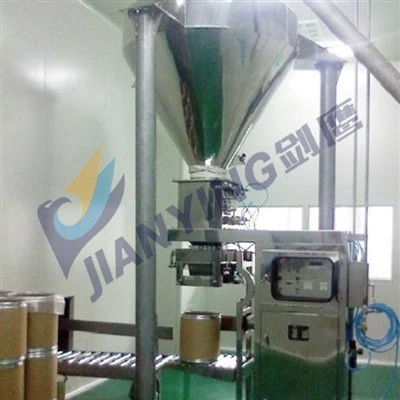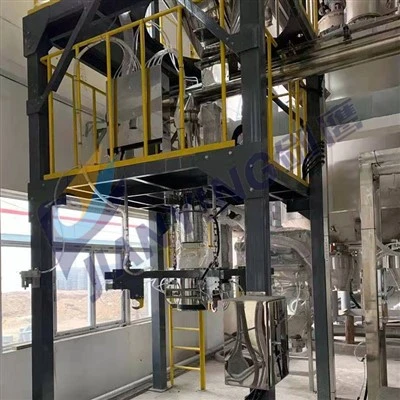
After verifying that the load cell wiring is correct, switch on the control cabinet power and allow a 15-minute warm-up period before proceeding with calibration. The following example outlines the procedure for a machine with a maximum capacity of 100 kg, a scale interval of 0.2 kg, a target weight of 90 kg, and an accuracy class meeting the X(0.2) requirement:
Off-Center Load Adjustment
Place a 10 kg test weight successively on each of the two load-bearing points of the weighing hopper. If the weight indicator shows a "positive error" (reading higher than actual weight), the load cell output should be adjusted downwards; if it shows a "negative error" (reading lower than actual weight), the output should be adjusted upwards. For example, to decrease the output of load cell L/C-1, rotate the associated set of trimming resistors (initial value: 10 ohms) to the left by an equal amount. Rotating to the right (clockwise) decreases resistance and increases the displayed value (denoted as "Add"); rotating to the left (counter-clockwise) increases resistance and decreases the displayed value (denoted as "Subtract"). Note: Inconsistent rotation between the two resistors in a set complicates the adjustment process; therefore, the rotation amount for each resistor in the set should be kept as uniform as possible. The adjustment is considered successful if the absolute error at each load-bearing point does not exceed 10 g.
Weighing Adjustment
Perform the weighing adjustment according to the calibration steps specified in the weight indicator/controller manual. During verification, increase the test weights in the sequence of 0 kg, 40 kg, 70 kg, 90 kg, and 100 kg (from zero to maximum capacity); the errors must not exceed 10 g, 20 g, 35 g, 45 g, and 50 g, respectively. Then, decrease the weights in the sequence of 100 kg, 90 kg, 70 kg, 40 kg, and 0 kg (from maximum capacity to zero); the errors must not exceed the respective permissible tolerances. Finally, conduct repeatability tests at the 40 kg and 100 kg set points; perform the test three times at each point, ensuring the error in each instance does not exceed the respective permissible tolerance.
Parameter Settings
Quantitative packaging scales require the configuration of numerous parameters; key parameters commonly used are described below: a. The quantitative value on the weighing controller can be set to the target weight (e.g., 90 kg). b. Fast-feed cutoff offset and slow-feed cutoff offset. When the weight exceeds (set value) minus (fast-feed cutoff offset), fast feeding stops and the process switches to slow feeding; when the weight exceeds (set value) minus (slow-feed cutoff offset), feeding stops completely.